
My crude oil trading strategy: How I trade oil in volatile markets


Discover how crude oil behaves in volatile market conditions and what it takes to trade it with clarity and confidence. This guide breaks down the fundamentals of oil trading, from market drivers to strategy, so you can approach every setup with a sharper edge.
I started trading crude oil because it creates setups that are somewhat easy to trade, allowing for clear entry and exit points. My introduction to the oil market opened my eyes to a market driven by global politics, real supply and demand, and hard data that actually matters. Oil behaves differently from forex, stocks, or crypto because it reacts instantly to real-world events. That said, volatility can chew you up if you’re unprepared, but it can also give you clean, high-probability setups if you know what you’re doing. The more time I spent trading crude, the more I realized that volatility wasn’t a threat but rather an advantage.
Content
- Understanding the oil market (The basics you must know)
- My oil trading strategy (Step-by-step)
- Tools and platforms I use
- Key factors that move crude oil prices
- Trading crude oil in your local region
- Lessons I learned the hard way
- Final thoughts: Is crude oil trading right for you?
- Frequently asked questions
key takeaways
- Crude oil reacts instantly to real-world events, making volatility both a challenge and an advantage. Because crude oil prices are heavily influenced by global supply shifts, geopolitical risks, and economic data releases, traders who understand these forces can utilize volatility to identify high-probability setups.
- Knowing the key benchmarks—WTI and Brent crude—is essential for successful oil trading. West Texas Intermediate (WTI) reflects US production levels while Brent tracks broader global demand. Both of these factors influence how oil traders interpret market prices on major exchanges, such as the New York Mercantile Exchange (NYMEX) and ICE.
- A simple technical toolkit—moving averages, Bollinger Bands, and oscillators—can provide clarity in fast-moving oil markets. These technical indicators help traders analyze crude oil futures, identify trend direction, and time entries and exits, whether they trade CFDs, futures contracts, or other financial instruments linked to actual oil.
- Risk management matters more in crude oil than in many other asset classes. With oil prices often spiking during geopolitical events or inventory releases, sizing small, respecting structure, and adapting to volatility are critical for anyone trading oil or oil-linked assets.
- Supply, demand, and geopolitical events remain the core drivers of the oil market. From OPEC decisions and Middle East tensions to the Ukraine war and shifts in global economic growth, these factors move crude oil prices more than technicals alone and guide how traders approach oil production trends, inventory data, and overall market sentiment.
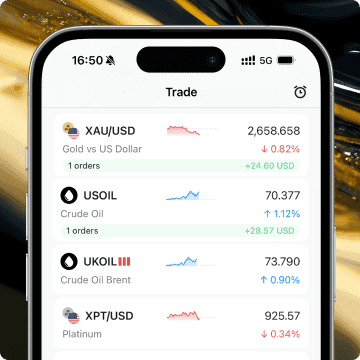
Plan your commodities trades
Use our tools to test your strategy on a free demo account.
Understanding the oil market (The basics you must know)
What is crude oil, and why is it traded?
Crude oil is the raw, unrefined commodity that powers global energy markets. It’s traded because everything from airlines to manufacturing depends on it, and changes in supply or demand ripple across the entire economy. Traders step in because these price swings create opportunities to profit from macro shifts, geopolitical tensions, and economic cycles.
The two major benchmarks (WTI vs Brent)
The two main benchmarks you’ll encounter are WTI (West Texas Intermediate) and Brent. WTI mainly reflects US supply conditions, while Brent represents global pricing. Brent usually trades at a slight premium because it’s tied to seaborne production and international demand. As a trader, you need to know which benchmark your broker offers and how each reacts differently to news.
Oil derivatives: Spot, futures, and CFDs
Oil isn’t traded in one simple form. You gain access through spot, futures, or CFDs, each with its own pros and cons. Spot gives you the price now, futures give you exposure to contracts with expiry, and CFDs let you speculate without dealing with contract rollovers. I trade CFDs because the execution is cleaner and the structure fits intraday volatility.
My oil trading strategy (Step-by-step)
Choosing the right timeframes for oil
Let me begin with this: there is no right or wrong timeframe to choose from; it all comes down to what style you prefer. Scalpers typically choose lower timeframes, such as 1-, 5-, or 15-minute frames, for example, whereas a swing trader may opt for 1- or 4-hour charts. Personally, I prefer to trade on the 4-hour or daily charts, but that doesn't mean I don’t check the weekly charts or 1-hour charts to gain more context on what's happening in the market. I almost never trade oil using only one timeframe because context is everything.
My go-to technical indicators
My approach to technical indicators is to keep them as simple as possible. Too many lines on the chart or too much unnecessary information tend to confuse traders. Personally, I maintain that the simpler it is, the better it is. I always use these indicators (in combination with some more, but let's stick to these three) to analyze any instrument:
- 50 and 100 SMAs. A longer-term simple moving average tends to ignore temporary noise and provide clear validation of the direction. In many cases, the trend is obvious, but what I really like about moving averages is the way they cross. That said, the longer-term SMAs tend to provide good entry points when they do cross.
- Bollinger Bands. I find Bollinger Bands to be extremely helpful in gauging volatility. What I find fascinating about them is that they do not only show the volatility in the market but also act as support and resistance areas on the price itself.
- Stochastic Oscillator. Some may argue that the RSI or the MACD oscillator is better for some reason, but they all essentially serve the same purpose: indicating overbought or oversold levels. In trending markets, such as crude oil, this indicator helps me validate or confirm areas of potential reversal, which in turn supports my overall trading strategy.
My entry and exit rules (with chart examples)
I enter only when the trend, structure, and momentum line up. For example:
- In an uptrend, I wait for a pullback to the 50 SMA and a strong bullish reaction.
- I exit at the next logical level, for example, previous highs, volatility breaks, or Fibonacci retracement levels.
- If price breaks structure against my trade, I’m out as fast as possible with no hesitation.

How I manage risk in volatile sessions
Oil requires tighter risk control than most markets. Therefore, I size small when volatility spikes, keep stops just beyond the structure, and accept that sometimes the smartest decision is not taking the trade. Volatile sessions reward precision, not aggression, and understanding commodity trading risk is essential for staying disciplined during fast-moving market conditions.
Tools and platforms I use
Charting tools and news data sources I rely on
For my charting needs, I use Exness’ online platform as well as TradingView. They both provide a clear picture of the markets, and they have all the tools and indicators that I use in my strategies. Now, when it comes to news feeds, I tend to rely more on real-time feeds focused on energy markets such as OPEC statements, geopolitical headlines, and inventory data. Most of these can be found on reliable sites like EIA.gov, API.org, and opec.org. I find that the data on these websites is usually up-to-date and can provide real insights into what’s happening in the crude oil market.

Key factors that move crude oil prices
Supply & demand dynamics
Crude oil reacts to production cuts, demand spikes, refinery output, and global consumption trends. Additionally, geopolitical tensions worldwide significantly impact the price of oil, as do weather conditions in major oil-producing countries. Therefore, we see that supply and demand aren’t theoretical here but rather drive real price changes.
Geopolitical events and OPEC decisions
Wars, sanctions, OPEC+ meetings, and political instability can move oil more in five minutes than some markets move in a month. If you trade oil, you must keep track of geopolitical developments.
Inventory reports (EIA/API)
I watch EIA every Wednesday and API on Tuesdays. Inventory surprises create explosive movement, and if you don’t prepare for them, you’ll get caught on the wrong side instantly.
Global macroeconomic indicators
Strong economies push demand; weak economies crush it. Inflation, interest rates, GDP, and industrial activity all shape oil’s long-term direction.
Trading crude oil in your local region
- Regulatory aspects: Different regions regulate derivatives differently. Know the rules before you trade so you’re not blindsided by restrictions or leverage limits.
- Local access to oil markets: Some countries offer full access to spot, futures, and CFDs. Others limit product types. You trade what your region allows.
- Paying attention to international benchmarks: Even if you’re trading locally, you follow global prices. Oil is international by nature.
Lessons I learned the hard way
- Mistakes I made starting out: I underestimated volatility and overestimated my readiness. Oil punished every lazy trade and every moment I wasn’t paying attention.
- What I’d do differently: I’d start with a smaller size, track news closely, and spend more time understanding macro trends before jumping into intraday trades.
- The most important thing every new oil trader needs to understand: Oil will move farther than you expect, faster than you expect, and against you when you get complacent. You survive by respecting volatility, not fighting it.
Trading glossary
WTI (West Texas Intermediate)
A major crude oil benchmark used to price US oil production, especially for futures traded on the New York Mercantile Exchange (NYMEX). It’s known for its low sulfur content and is often referenced by traders tracking crude oil prices and global supply trends.
Brent Crude
A globally recognized benchmark sourced from the North Sea, widely used in international oil trading. Brent crude reflects broader global demand conditions and is a key reference point for oil futures and market prices.
Bollinger Bands
A technical analysis tool that measures volatility by placing dynamic bands around price movements. In oil trading, Bollinger Bands help traders identify potential reversals or breakouts in crude oil futures or CFDs, especially during periods of rising volatility.
Inventory Reports (EIA/API)
Weekly economic data releases from the US Energy Information Administration (EIA) and American Petroleum Institute (API) that track crude oil, gasoline, and natural gas stock levels. These reports can shift crude oil prices sharply because they reveal real-time changes in supply, demand, and refinery output.
CFDs (Contracts for Difference)
A financial instrument that allows traders to speculate on oil price movements without owning the actual oil. CFDs are popular in crude oil trading because they avoid fixed expiry dates associated with futures contracts and offer flexible access to market movements.
Capitalize on market trends
Trade metals and energy price movements with low, stable spreads.
Final thoughts: Is crude oil trading right for you?
Oil trading isn’t for everyone, but certain personality traits make the journey far more manageable. If you can stay calm under pressure, adapt quickly, and make confident decisions without hesitation, you’ll naturally fit the fast-moving environment of crude oil markets. The traders who thrive are the ones who remain level-headed even when volatility spikes.
Balancing risk and reward is at the heart of long-term success. Oil rewards discipline and structure—those who wait for clean setups, follow their plan, and protect their capital. On the other hand, chasing price or trading emotionally can undo progress in minutes. In this market, risk management isn’t an afterthought; it’s the foundation.
If you’re considering trading crude oil, focus on truly understanding the market instead of forcing trades that aren’t there. Volatility can be your greatest advantage when you’re prepared, but it quickly becomes your enemy when you’re not paying attention. Before risking real capital, test your strategy in a risk-free demo environment to build confidence, refine your approach, and learn how oil behaves under different market conditions.
Frequently asked questions
What does an oil trader do?
An oil trader analyzes global energy trends, price action, and news to buy and sell crude oil or related products for profit.
How profitable is oil trading?
It can be profitable, but only if you trade with discipline. Oil rewards skill and punishes impulsiveness.
How do I get into oil trading?
Open an account with Exness, as they offer access to oil markets. Then learn the fundamentals, practice on a demo account, and start small.
How much do oil traders earn?
It varies widely depending on your available capital to invest, but the key is to be consistent. Skilled traders consistently earn a profit, while undisciplined traders often fail to succeed in this field.
What is crude oil?
Unrefined petroleum that becomes fuel, plastics, and countless industrial products.
Where does crude oil come from?
It is extracted from underground reservoirs worldwide, primarily from countries such as those in the Middle East, the US, Africa, South America, and several others.
What is the difference between oil and crude?
“Crude” is the raw product. “Oil” can refer to either crude or refined forms, such as gasoline or diesel.
Share:
Related


Exness Trade app
Trade with confidence anytime, anywhere.


Get the app
App title

Trading is risky. T&Cs apply.


