
Bollinger Bands strategy: How to trade volatility and spot reversals


Some markets can be highly volatile, but there are strategies to work with them. The Bollinger Bands strategy, for instance, could be the perfect addition to your trading arsenal.
“Volatility” is known to cause jitters for first-time traders. In markets like BTCUSD and EURUSD, the term and concept are commonplace, making the risk seem unpredictable and, at times, intimidating. But rather than being a threat, volatility can be an opportunity.
Managed correctly, and with the right tools in place, traders can take advantage of price swings to enter and exit trades more strategically, potentially maximising gains while controlling that risk.
Bollinger Bands are one of these tools, helping traders identify trends, reversals, and breakout opportunities, but how do they work, and how exactly can you trade with them? Here’s our full, practical “how-to” guide to answer those questions.
Christopher Tahir, Exness market analyst and trading specialist, also shares a step-by-step breakdown on how to trade with Bollinger Bands.
Content
- What are Bollinger Bands, and how do they work?
- How to use Bollinger Bands in trading
- What are the Best Bollinger Band settings?
- Bollinger Bands strategy example: EURUSD trade walkthrough
- Tips for trading with Bollinger Bands effectively
- Is the Bollinger Bands strategy right for you?
- Key takeaways
- Final thoughts on mastering the Bollinger Bands strategy
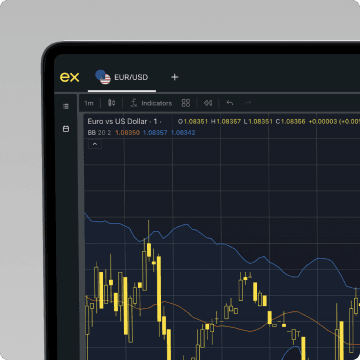
Make smarter trading decisions
Use expert analysis and tools on demo accounts or a live account.
What are Bollinger Bands, and how do they work?
If volatility is the mood of the market, then Bollinger Bands are the mood rings. They help you visualise how the market is feeling, and whether prices are running hot, running cold, or staying steady. You have to learn how to read Bollinger bands to be able to get into the market’s heart.
Bollinger Bands are listed among the top forex indicators by seasoned traders, and they consist of three lines:
- The middle band—a simple moving average that shows the average price over a set period.
- The upper band—calculated by adding two times the standard deviation to the SMA.
- The lower band—calculated by subtracting two times the same deviation.
Middle Band | 20-period SMA |
Upper Band | SMA + 20-period SD x2 |
Lower Band | SMA - 20-period SD x2 |
For anyone unsure of what “standard deviation” means, this is essentially a measure of how much prices are swinging around the average. A high standard deviation means prices are bouncing around a lot, while a low standard deviation means prices are staying closer to the average. Together, the three bands create a visual “tunnel” around the price, expanding when the market is jumpy and contracting when it’s calm. Here’s a quick look:

How to use Bollinger Bands in trading
When using Bollinger Bands in trading, they shouldn’t be taken as gospel. By that, we mean, when the price touches the upper band, it doesn’t necessarily mean you should sell, and vice versa. When it touches the lower band, this isn’t a definitive signal that you should buy. Data is only as good as your interpretation and decisions; remember that.
The inventor, John Bollinger himself, said, “There is absolutely nothing about a tag of a band that in and of itself is a signal.” So, like a mood ring, they should always be taken with a pinch of salt. That being said, using them in trading can be highly effective if you know what you’re doing.
Bollinger Bands appear in Exness Insights’ Top-20 trading indicators as a key technical analysis tool.
How to read Bollinger Bands
Learning how to read Bollinger Bands is about understanding the relationship between price action and the three bands. When prices approach the upper band, it shows that the market is trading near its recent highs, which can indicate strength or potential overbought conditions. When prices approach the lower band, the market is near its recent lows, suggesting weakness or possible oversold conditions.
The middle band—a simple moving average—acts as a dynamic trendline. When prices stay above the middle band, it generally confirms an uptrend; when they remain below it, the market is trending downward.
You can also observe the width of the bands to gauge volatility. Wide bands mean the market is volatile, while narrow bands (a “Bollinger Band squeeze”) often precede a breakout. Combining this reading with other technical analysis tools, like RSI or MACD, helps confirm momentum and avoid false signals.
Tip: Always practice how to read Bollinger Bands in your Exness demo account before applying the strategy to live markets. It’s the best way to train your eye to recognize volatility patterns and price behavior in real time.
Spotting overbought and oversold conditions
When the price touches the upper band, it may indicate that the market is overbought, and when it touches the lower band, it may indicate that the market is oversold. However, don’t rely on bands alone to confirm signals. Additional indicators, like RSI, volume analysis, and trend analysis, should be used to confirm whether a potential reversal or continuation is likely. It’s a team sport.
Identifying trend continuation vs reversal
In terms of identifying those potential continuations or reversals, it’s all about watching how the price interacts with the upper and lower bands and the slope of the middle band.
If the price rides along the upper band and the middle band is sloping upward, this suggests a strong uptrend that may continue. If the price clings to the lower band with a downward-sloping middle band, this indicates a strong downtrend. On the other hand, if the price breaks a band and forms a reversal pattern, this could signal a potential turning point, indicating that the market might be about to change direction.
Again, the break of a band alone isn’t enough to act on; it’s the combination of the break and the reversal pattern that provides a stronger signal. Therefore, you should look for confirmation of this from other indicators, ensuring that you test them first in your Exness demo account.
What are the Best Bollinger Band settings?
The default setting for Bollinger Bands is a 20-period SMA with two standard deviations. It strikes a nice balance between sensitivity and reliability: the 20-period SMA captures a solid average without overreacting to short-term price swings, while two standard deviations cover about 95% of price action, helping identify potential overbought or oversold conditions.
You can adjust these settings, of course, and 1.5 or 2.5 standard deviations are often used to make the bands tighter or wider, depending on strategies. But again, it’s best to do so in an Exness demo account if you want to test and see how different settings affect signals without risking funds.
Settings for day traders vs swing traders
Looking a little deeper into those setting adjustments, there are two distinct options you can choose if you’re a day trader or swing trader.
For day traders, a shorter SMA—around 10-14 periods—might be best for faster responsiveness, while smaller standard deviations—around 1.5 to 2—can be used to capture short-term price movements. If you’re a swing trader, a longer SMA, around 20-50 periods, can smooth out the noise and focus on broader trends, while standard deviations, at two or higher, will avoid false signals from short-term fluctuations.
In any case, it’s all about consistency and making sure the settings align with your time horizon and trading goals, which helps you interpret signals more efficiently.
- Day Traders: Shorter SMA (10-14), smaller deviations (1.5 to 2).
- Swing Traders: Longer SMA (20-50), standard deviations at 2+.
Swing traders can benefit from Exness Insights’ Bollinger Bands for volatility analysis in swing trading.
Bollinger Bands strategy example: EURUSD trade walkthrough
The information above provides everything you need to know about how Bollinger Bands work and which setting might be best for your trading style. However, what about a practical, step-by-step example? Let’s do this by looking at the EURUSD market, one of the most actively traded and liquid currency pairs in the world, making it a particularly volatile environment for applying Bollinger Bands effectively.
Bollinger Band setup
The first thing you need to do for a Bollinger Band setup is organise the bands, using your chosen settings to match your trading timeframe.

Breakout
Next, you would watch for the price to squeeze within the bands and then break out, either above the upper band or below the lower band.
This aligns with the ideas shared in the Exness Insight article on breakout setups with Bollinger Bands.

Entry point
Your entry point would be just after the breakout is confirmed. For instance, if the price broke above the upper band, and other indicators confirmed upward momentum, you might enter a long position. Conversely, if the price broke below the lower band with supporting indicators, you might enter a short position.

Exit point
The exit can be determined by either the opposite band, a set profit target, or a trailing stop. For instance, if you went long on a breakout above the upper band, you might set your exit near the middle band if the trend shows signs of weakening, or ride the trend further while adjusting a trailing stop to protect your profits.
You can also discover how to apply Bollinger Bands to commodities in this article in Exness Insights.

Tips for trading with Bollinger Bands effectively
Trading effectively with Bollinger Bands comes with practice, patience, and a clear strategy. What might work for day traders won’t necessarily have the same power for swing traders or long-term investors, and vice versa. There are some tips we can offer that apply to traders of all levels and styles:
- Combine with RSI or MACD for confirmation.
- Use the “squeeze” as a breakout alert.
- Use multiple timeframes.
- Avoid trading every band that touches.
- Be wary of overbought/oversold extremes.
- Set stop losses strategically.
- Test settings on a demo account before applying them live.
Also refer to Exness’s article on the best indicators for day trading for further combinations.
Is the Bollinger Bands strategy right for you?
Generally speaking, the Bollinger Bands strategy can work for any type of trader. If you follow what Bollinger himself said about not relying on the bands as clear signals, you can use them as a tool to provide context rather than strict instructions, helping you understand whether the market is trending, overextended, or likely to experience a breakout.
For example, if you’re a scalper, you can benefit from quick volatility cues so long as you manage the noise. If you’re a swing trader, you can catch breakouts and trend continuation, and if you’re a long-term investor, you can spot broader market trends and identify periods of unusually high or low volatility.
For beginners, always practice in a demo account first. Bollinger Bands are accessible, but they require discipline to use effectively. So, start small and focus on learning how the bands respond to different market conditions.
You can also read Exness Insights’ overview of CFD and forex strategies using Bollinger Bands.
Look at the technical view
Execute your next move with confidence using a range of advanced technical indicators.
Key takeaways
- The Bollinger Bands strategy helps traders measure market volatility effectively. This powerful technical analysis tool visualizes price movements, identifies trend reversals, and shows when stock prices are expanding or contracting within the upper and lower bands.
- Understanding Bollinger Bands starts with mastering the upper, middle, and lower bands. The middle Bollinger band (a moving average) reflects the average price, while the upper and lower Bollinger bands—based on standard deviations—measure price volatility and the strength of potential market movements.
- Bands expand and contract to reveal changing market conditions. When bands widen, they signal high volatility and possible breakouts; when bands narrow, they indicate low volatility or a ranging market, which often precedes a Bollinger Band squeeze strategy setup.
- Touches near the upper or lower Bollinger bands can signal overbought or oversold conditions. When price touches the upper Bollinger band, it may point to overbought territory, while touches on the lower Bollinger band can hint at oversold conditions—but always confirm with other indicators to avoid false signals, as John Bollinger advised.
- Bollinger Bands work best when combined with other technical analysis tools. They reflect trading bands that show market conditions, but traders should pair them with RSI, MACD, or volume indicators to confirm trading signals and filter out noise.
- The middle line of the Bollinger Bands acts as dynamic support or resistance. When prices remain above the middle band, the trend is upward; staying below suggests a downward trend. Many traders use this moving average as a guide for trading decisions and exit points.
- Bollinger Band settings can be customized for any trading style. The default 20-period moving average with two standard deviations suits most markets, but day traders may tighten their bands for quicker reactions, while swing traders may use longer settings to identify strong trends.
- Bollinger Band width helps anticipate major price movements. A narrow Bollinger Band width suggests a period of low volatility before a significant price move, while wide bands indicate high volatility. Watching for a Bollinger Band squeeze can help traders prepare for breakouts.
- Effective Bollinger Band trading requires confirmation and risk management. Bollinger Bands typically work best when used alongside other indicators to confirm price breaks, price targets, and potential reversals, forming a reliable and disciplined trading strategy.
- Consistency and discipline are key to mastering the Bollinger Band strategy. By testing Bollinger Band setups on a risk-free demo account, traders can learn how the bands expand and contract under different market conditions, improving their interpretation of trading signals and achieving more confident trading outcomes.
Final thoughts on mastering the Bollinger Bands strategy
Above all, any trader, whether they’re a beginner or a seasoned professional, should remember the importance of combining Bollinger Bands with other indicators, working to confirm the signals and manage risk effectively.
Again, this is where the Exness demo comes into play, giving you the space and freedom to test different tools and formulate a solid, cohesive trading plan.
Volatility is not necessarily a hindrance; it’s a key to improved trading decisions. However, this key can only be used if you have a clear understanding of volatility and the discipline to manage the risk correctly.
For more on how Bollinger Bands fit into a broader profitable trading strategy, see Maria Agustina Patti’s essential steps to successful trading using Bollinger Bands.
Share:
Related


Exness Trade app
Trade with confidence anytime, anywhere.


Get the app
App title

Trading is risky. T&Cs apply.


