
How to spot patterns in trading charts: A beginner's guide


Price movements create patterns—increases, decreases, uptrends, downtrends. If you study the charts, you can find the patterns, and once you know how to find patterns in trading charts, you can make better trading decisions.
When I first started learning about patterns in trading charts, I remember staring at price charts that looked like nothing more than random lines and candles. I never heard of things like reversal and flag patterns. And, as far as I was concerned, Head and Shoulders was just a dandruff shampoo we used back in the 90s to tame our wild teenager hair.
Over time, through practice and plenty of mistakes, I began to recognize and spot these common chart patterns like the head and shoulders (not the shampoo), double top pattern, and cup and handle pattern. These price patterns helped me understand how support and resistance levels worked, when a possible trend reversal might happen, and how continuation patterns often signaled that the prevailing trend would keep moving in the same direction. Looking back, I can say that chart pattern analysis completely changed how I approached my trading strategy and gave me more confidence in reading stock chart patterns, even when market volatility made the price action look unpredictable.
Content
- What are trading chart patterns, and why they matter
- Key types of trading chart patterns you should know
- Most common chart patterns and how to recognize them
- How to use patterns in your trading strategy
- Mistakes to avoid when trading chart patterns
- Tools and platforms to help you spot chart patterns
- Key takeaways
- Frequently asked questions about patterns in trading charts
- Final thoughts and tips for beginners
What are trading chart patterns, and why they matter
Analyzing patterns in trading charts is key to any trader’s skill set. To the untrained eye, all those charts and patterns can be confusing. However, with a little knowledge and a lot of practice, even absolute beginners can master patterns in trading charts.
A simple definition of trading chart patterns
Trading charts create discernible patterns. Often drawn as lines that connect prices, patterns in trading charts can be used to judge the direction in which the price is moving.
Why traders use patterns to make decisions
If a pattern has occurred in the past, it may happen again in the future, potentially helping traders to plot future price trends.
A trader can use patterns in trading charts to judge the best entry and exit points, set stop loss and take profit orders, and get a feel for how a price might fluctuate over time. Patterns establish structure; they create order and predictability in disorder and unpredictable markets.
How patterns reveal market psychology
In addition to highlighting ideal entry/exit points, patterns in trading charts can also teach you about market psychology. How did the market react to certain geopolitical news? How is the market currently moving in light of a recent economic event?
The more you know about the market and how it reacts, the more effective a trader you will become.
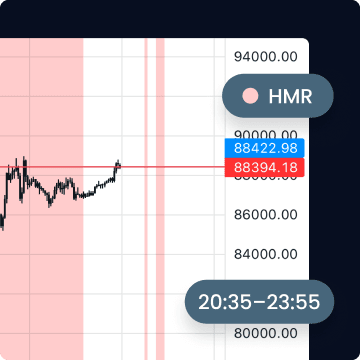
Your trading toolkit matters
We offer advanced trading tools to enhance your efficiency and precision.
Key types of trading chart patterns you should know
Patterns in trading charts can take various forms, depending on the market and the predicted direction of the trend. These include various reversal, continuation, and bilateral patterns. Learning how to identify them will help you judge market sentiment.
Reversal patterns: Signals of trend changes
Reversal patterns indicate that the market could be about to shift, moving into either a bullish or bearish trend. The price stalls and then adopts either an upward or downward trend, with the former coming during an existing downtrend and the latter appearing during an uptrend.
The pattern is determined by the direction of the trend, market movement, and the strength of the pattern change. For instance, the double top pattern is a bearish reversal, which means the trend was bullish and could become bearish, while the double bottoms indicate the opposite, beginning bearish and moving into bullish.
Continuation patterns: Trends that keep moving
A continuation pattern is one that signals a continuation of an existing trend. They indicate a consolidation and can be seen in all chart timeframes. They are not 100% reliable, though, as false breakouts and reversals can occur, so traders should keep this in mind when analyzing patterns in trading charts.
Some of the most common continuation trends include triangles, rectangles, flags, and pennants. An ascending triangle, for instance, forms an ascending line across higher lows and a flat line across the highs. The flat line is the resistance line, and a breakout could occur above this line, suggesting that the buyers are pushing up the price.
Bilateral patterns: When the market can go either way
Some patterns are harder to predict than others. Bilateral trading patterns are a prime example. These indecisive patterns don’t point to a specific direction and could move either way.
The price bounces between lines of support and resistance and doesn’t fully form a trend. The trader then uses their analytical skills to gauge a direction and act on it when it appears.
A symmetrical triangle pattern, which forms two converging lines, is one such pattern. It’s neither bearish nor bullish and indicates market indecision, as it anticipates a breakout in either direction.
Most common chart patterns and how to recognize them
Focusing on the most common patterns in trading charts will ensure you’re ready for more high-level trading.
Head and shoulders
The head and shoulders pattern is named for its three pushes, with the sides acting as the shoulders and the middle constituting the head. The left shoulder forms at the peak of a major market move, with traders then losing interest as the price drops. Enthusiasm increases to form a higher high, before dropping to its previous low and forming a right shoulder that mirrors the left.
The head and shoulders pattern includes a neckline—a line drawn along the shoulder troughs. It is a bearish pattern, but an inverse head and shoulders is bullish.

Double tops and bottoms
Double tops and bottoms are two classic chart patterns. Both are reversal patterns, with double tops indicating a bearish reversal and double bottoms suggesting a bullish reversal.
The double top appears as two peaks that show an asset reaching a high price and then falling. A support line is drawn across the low points between the two highs, and the pattern is confirmed when the price breaks these lines. It’s a bearish pattern that shows the price has reached a resistance line twice, but has failed to break it.
The double bottom is the reversal of a double top. It’s a bullish pattern with two similar price bottoms and a resistance line across the high points. The pattern is confirmed when this line is broken in an uptrend.
Triangles (ascending, descending, symmetrical)
There are three main types of triangle patterns:
- Ascending triangles: An ascending line formed by higher lows connects a flat resistance line across the highs. It suggests an uptrend.
- Descending triangles: An inverted version of the ascending triangle, descending triangles are formed by a flat resistance line connecting the lows and a descending line across lower highs. It indicates a downtrend.
- Symmetrical triangles: Both lines are diagonal and converge, with the upper connecting lower highs and the lower connecting higher lows. The upper line will likely breach as the line moves to the apex.
Flags and pennants
Flags and pennants are continuation patterns.
Flags suggest a previous trend will continue after a momentary consolidation period. A bullish flag pattern is formed by two downward parallel lines across the highs and lows. This illustrates the consolidation period, after which the trend breaks upward. A bearish pattern is the opposite, with upward parallel lines that then break downward.
Pennants are continuation patterns that work in a similar way. The difference is that the lines converge, starting with higher peaks and troughs that eventually get smaller.

Cup and handle
As a bullish continuation pattern, the cup and handle can signal the ideal moment to buy. The cup is a U-shaped pattern followed by a small drop and a rise that creates a smaller U-shaped handle. The cup aspect of this pattern should be somewhat shallow and needs to form a “U” and not a “V”, while the handle’s drop should be a retracement of between 30-50% of the cup’s high.
The cup shows rapid decline and recovery; the handle signifies resistance before a breakout.
How to use patterns in your trading strategy
Learning how to find and analyze patterns in trading charts can give you an idea of when to enter/exit the market, while also guiding stop loss and take profit orders. They are an essential part of the technical analysis process.
Entry and exit points using patterns
Once you learn patterns in trading charts, you will find optimal moments to buy or short.
For example, let’s say that you’ve identified the head or shoulders pattern. As soon as the price breaks the neckline, you know that the market has entered bearish territory, so you may decide to open a short position before exiting the position and taking a profit when you’ve reached your target level.
If you’ve identified an ascending triangle, you may decide to buy when the resistance line breaks and the price climbs higher.
Combining chart patterns with technical indicators
Technical indicators are mathematical calculations that combine various factors, including the price and volume of an asset. In combination with chart patterns, technical indicators can give traders a broader view of the market and help them to define better entry and exit points.
The relative strength index is used to determine if an asset is oversold or overbought. If it’s used alongside a triangle pattern, it can indicate the strength of a breakout. The Moving Average Convergence Divergence, known simply as “MACD”, is effective at spotting trend reversals and can strengthen a short position after a head and shoulders breakout.
Indicators identify patterns in trading charts, adding an extra layer of complexity, but they also help traders confirm those patterns and act with confidence.
Timeframes that matter for pattern trading
You can find patterns in trading charts across all timeframes, but you may need to adjust to adapt:
- Short (5 to 15 minutes): Popular with day traders and scalpers, the signals are quick, but there’s a lot of noise and the potential for false patterns.
- Medium (1 to 4 hours): Used by swing traders, there is less noise, more balance, and frequent signals.
- Long (Daily+): Patterns are more reliable, but signals are slower.


Mistakes to avoid when trading chart patterns
Everyone is prone to making mistakes—look out for these common errors when analyzing patterns in trading charts:
Ignoring confirmation signals
Waiting for confirmation signals helps traders avoid false breakouts and ensure there is strong support behind the trend.
You shouldn’t ignore these confirmations and rush in, but at the same time, you don’t need to wait for every signal.
Signal examples include high trading volume, as well as indicators like the relative strength index.

Overtrading based on weak patterns
Inexperienced traders often try to force patterns, believing that they’re looking at a stronger pattern than they are. They see what isn’t there, bend the rules to force the pattern into shape, and then overcommit. Be patient and keep looking—those patterns will appear.
Not adjusting for different market conditions
Traders don’t simply study patterns and hope that they repeat. They will also check the market and judge how certain conditions and geopolitical news will impact their trades. Using patterns in trading charts gives you a strong foundation, but soft commodities are impacted by extreme weather changes, stocks fluctuate based on taxes and tariffs, and most assets are impacted by war and upheaval. You should always consider the conditions under which these assets are traded.
Tools and platforms to help you spot chart patterns
You can’t be expected to find and analyze all those patterns on your own, and you don’t need to. These tools will help you with finding patterns in trading charts:
Charting software options
Although there are various paid tools available, you can also find detailed free tools in the Exness Terminal, the Exness Trade app, and MetaTrader 4 and MetaTrader 5 platforms.
You can customize the charts and chart timeframes and add various indicators, such as moving averages and the Relative Strength Index (RSI).

Using AI and pattern recognition tools
Artificial intelligence is very good at spotting patterns and can effectively identify patterns in trading charts. Machine learning tools known as convolutional neural networks can study financial data and find preprogrammed patterns to potentially predict market direction, while natural language processing programs gauge market sentiment.
However, many AI tools are overly reliant on historical data and lack that human touch. A trader can use judgment based on experience, context, and intuition—AI can’t. AI tools can be helpful, but it’s best not to completely eliminate human interaction.
Free vs. paid tools
Many traders argue that there isn’t much, if any, difference between free and paid tools. It’s true that low-quality free tools simply aren’t comparable to the best paid alternatives, but if you stick with trusted programs, such as the array of free tools available to Exness members, you’ll find everything you need.
Key takeaways
- Patterns in trading charts are essential for technical analysis. They provide structure in unpredictable markets, helping traders identify possible trend reversal or continuation patterns.
- Reversal patterns signal when the prevailing trend may change direction. Classic examples include the head and shoulders, double top pattern, and double bottom, which can indicate either a bullish reversal or a bearish reversal.
- Continuation chart patterns show when a trend is likely to keep moving in the same direction. Common chart patterns like bull flag pattern, pennants, and ascending triangle suggest that price action is consolidating before the next breakout.
- Bilateral patterns reflect indecision and can break in either direction. A symmetrical triangle pattern or wedge pattern forms between two trend lines, with traders watching closely for price breaks above resistance or below support.
- Recognizing the most common chart patterns builds trading confidence. Patterns such as the cup and handle pattern, rising wedge pattern, and descending triangle pattern appear frequently across stock chart patterns and forex charts.
- Chart pattern analysis works best when combined with indicators. Tools like RSI, MACD, and moving averages confirm signals, making it easier to validate price patterns and avoid false breakouts.
- Timeframes matter when spotting different chart patterns. Shorter charts capture fast price movement but add noise, while daily or weekly stock charts make it easier to identify reliable support and resistance levels.
- Market psychology is reflected in price patterns. Chart formations show how traders react to news and volatility, whether through accumulation patterns in an upward trend or distribution patterns in a falling market.
- Avoid common mistakes like forcing weak patterns or ignoring confirmation. Waiting for price action, volume, or technical indicators to align with a pattern form reduces the risk of acting on false signals.
- Practice is key to mastering trading chart patterns. Using a demo account, such as the Exness risk-free demo account, lets you test your trading strategy, track past performance, and improve at spotting popular chart patterns without risking real money.
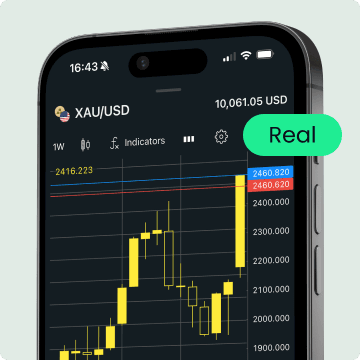
Exness Trade app
Trade with confidence anytime, anywhere.
Frequently asked questions about patterns in trading charts
How many chart patterns are there in trading?
There are more than 30 recognized chart patterns in trading, including reversal chart patterns, continuation patterns, and bilateral patterns. Traders often focus on the most common chart patterns, such as head and shoulders, double top pattern, cup and handle pattern, triangles, and wedge pattern, to guide their trading strategy.
Which is the best chart pattern?
There isn’t one “best” chart pattern, but some of the most popular chart patterns include the head and shoulders, double bottom, and the cup and handle pattern. These price patterns are often considered reliable because they provide clear support and resistance levels and can signal either a bullish reversal pattern or bearish reversal pattern depending on the prevailing trend.
How to use chart patterns for trading?
To use chart patterns in trading, first identify patterns in trading charts, such as triangles, flags, or double tops. Confirm the pattern forms with technical indicators or volume before making decisions on entry, exit, or stop loss levels. Chart pattern analysis works best when combined with technical analysis tools and risk management.
What is the 5-3-1 rule in trading?
The 5-3-1 rule in trading helps beginners simplify their trading strategy by focusing on five currency pairs, three proven trading strategies, and one specific trading session. While it doesn’t relate to specific chart patterns, it keeps traders disciplined while they learn to spot patterns like continuation chart patterns or reversal chart patterns in trading charts.
What are the most reliable trading chart patterns?
Some of the most reliable trading chart patterns include the head and shoulders, double top pattern, double bottom, and the bull flag pattern. The symmetrical triangle pattern and cup and handle pattern are also popular chart patterns that can provide high-probability signals when confirmed with indicators and strong price action.
Can beginners trade using chart patterns alone?
Beginners can start learning from common chart patterns like ascending triangle, falling wedge, or double top, but they shouldn’t rely on them alone. Trading chart patterns work best when combined with technical analysis, volume, and other indicators to confirm possible trend reversal or continuation in the asset’s price.
Which timeframe is best for spotting chart patterns?
The best timeframe depends on your trading style. Short-term traders may analyze 5–15 minute price charts for fast patterns like bull flag pattern or descending triangle pattern, while swing traders often prefer 1–4 hour stock charts to spot ongoing trend continuation patterns. For long-term analysis, daily bar charts or weekly stock chart patterns provide more reliable signals and reduce market volatility noise.
Final thoughts and tips for beginners
From my own experience, learning to recognize patterns in trading charts was the turning point in building confidence as a trader. These price patterns—from simple double tops to more advanced formations like the cup and handle pattern—can give you structure in the middle of market volatility and help you define better entry and exit points. But no matter how clear a chart pattern looks, remember that technical analysis is about probabilities, not certainties.
As a beginner, the smartest step you can take is to practice in a risk-free environment. The Exness demo account is ideal for this—it allows you to apply chart pattern analysis, test strategies, and get familiar with reversal patterns, continuation patterns, and support and resistance levels without risking real money. The more you practice, the more spotting a bullish continuation pattern, identifying a trend reversal, or confirming a breakout above a resistance line becomes second nature.
Keep a trading journal as you progress. Record your observations, wins, and mistakes, and review them regularly to see how your ability to spot patterns develops over time. With patience and consistency, you’ll gain the confidence to move from demo trading to live markets and turn knowledge of trading chart patterns into a valuable skill set.
Ready to put this into practice? Start spotting patterns today on the Exness demo account and build your trading confidence step by step.
Share:
Related


Exness Trade app
Trade with confidence anytime, anywhere.


Get the app
App title

Trading is risky. T&Cs apply.

