
RSI trading strategy for beginners: Divergence and calculation


Want to know how traders use the RSI trading strategy to spot market reversals before they happen? In this article, Antreas Themistokleous breaks down RSI divergence and RSI calculation methods, showing beginners how to interpret momentum shifts and make more informed trading decisions.
When I first started trading, the RSI trading strategy quickly became one of my go-to tools for understanding market momentum. The Relative Strength Index helped me identify overbought and oversold conditions, but what really made a difference was learning how to spot RSI divergence—moments when price and momentum start moving in opposite directions. Over time, understanding the RSI calculation and how to apply it in real trading scenarios gave me a clearer edge, allowing me to time entries and exits with greater confidence.
What is the Relative Strength Index (RSI)?
Almost as soon as I entered the trading world, the RSI trading strategy became a big part of my technical toolkit. Developed by J. Welles Wilder in the late 1970s, the reason this tool has stood the test of time is that it’s one of the most powerful ways to gauge market momentum in a simple, visual format.

Unlike other complex indicators, RSI distills price action into a single oscillator that moves between 0 and 100, which provides a pretty clear image of what's happening in the market
By comparing the magnitude of recent gains to recent losses, I can easily deduce whether buyers or sellers are in control, allowing me to not only spot when the market is overextended but also identify potential entry points when prices are oversold.
However, as with any technical indicator, gather additional information and context before you go plowing ahead.
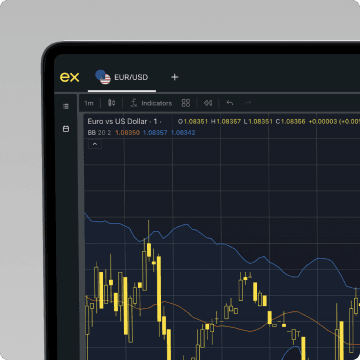
Look at the technical view
Execute your next move with confidence using a range of advanced technical indicators.
How is RSI calculated?
Let’s start with RSI calculation. In simple terms, the formula is where RS (Relative Strength) equals the average gain divided by average loss:
- RSI = 100 - (100 / (1 + RS))
The RSI formula explained
This means that, whenever you’re applying an RSI calculation to a chart, you’re measuring the ratio of average gains to average losses over a set period, which most commonly is 14 periods. A higher average gain compared to average loss pushes RSI closer to 100, showing that the asset is gaining strong upward momentum. A higher average loss compared to average gain pushes the RSI closer to 0, indicating downward momentum.
Key levels in RSI (30, 70, 50)
The key levels to look out for—30, 70, and 50—often serve as confirmation zones in day trading strategies that rely on RSI momentum shifts. These will help you interpret market momentum and potential reversal points.
For instance, when the RSI is above 70, it suggests that the asset is overbought, indicating that buyers have dominated for some time, and a pullback or correction may be near.
If the RSI is around 50, it indicates that the market is neutral, with no particular trend in either direction. Lastly, if it’s below 30, that indicates the asset is oversold, meaning sellers have dominated, and a potential rebound might be about to occur.
These levels aren’t strict “buy or sell” signals on their own, but they are useful for getting an overall picture of the market and confirming trends.
Understanding RSI divergence
One of the key benefits of using RSI, as demonstrated in optimized Relative Strength Index indicator strategies, is that it can be utilized to identify divergence between price and momentum. This occurs when the price of an asset moves in one direction while the RSI moves in the opposite direction, hinting that the current trend may be weakening.
Bullish divergence
Bullish divergence occurs when the price makes a lower low, but the RSI makes a higher low. This suggests that selling pressure is fading, and a potential upward reversal could be near.

Bearish divergence
Bearish divergence occurs when the price makes a higher high, but RSI makes a lower high, indicating that buying momentum is weakening and a potential downward reversal is approaching.

Hidden divergence
Many believe there are two types of RSI divergence: bullish and bearish, but if you look a little closer, there is another that sometimes rears its head. Unlike regular divergence, hidden divergence is when there’s a continuation signal rather than a reversal, suggesting that the current trend still has strength and is likely to keep moving in the same direction.

How I use RSI in practice
To use RSI in practice, it’s up to you to interpret these divergence signals effectively, while also considering the broader context of what RSI is offering, including momentum, overbought/oversold levels, and trend strength.
Spotting overbought and oversold levels
One of the simplest ways I use RSI in practice is by analyzing whether the line is crossing above 70 or falling below 30. As I mentioned before, the former indicates that the asset has been bought aggressively and may be due for a pullback or consolidation, while the latter indicates that selling pressure is strong and a rebound is approaching.
Combining RSI with support and resistance
I also combine RSI with support and resistance. If the RSI indicates an oversold condition near a strong support level, it increases the likelihood of a rebound, making it a more attractive entry point. Conversely, if the RSI indicates an overbought condition near a resistance level, this suggests a high probability of a pullback, signaling a potential exit.
Filtering out false signals
I also work hard to filter out false signals, or “RSI traps,” where momentum seems strong but the trend persists. The way I do this is by relying on both RSI and a number of other indicators, including:
MACD—Tells me about momentum shifts and potential trend changes.
Bollinger Bands help me identify volatility and whether the price is reaching extreme levels relative to its recent range.
Stochastic Oscillator—Gives an extra layer of confirmation on overbought and oversold conditions.
Combining all these indicators helps filter out misleading signals, while also increasing the probability that the trade I make will be the right one.
Best RSI strategies for different trading styles
That being said, each trade I make is determined by my own unique trading style, so it might be different for you. Across the trading landscape, RSI is being used in flexible ways to fit various timeframes and approaches, much like it does in swing trading strategies, where momentum confirmation plays a key role. Before you get started, it’s essential to identify your trading style and how the RSI can complement your strategy within that context.
Day trading with RSI
For day trading, it’s common to use a shorter timeframe for intraday signals, such as 5-minute or 15-minute charts.
Swing trading with RSI divergence
For swing trading, divergence tends to work better on 4-hour or daily charts, as traders seek to minimize noise and capitalize on larger price movements.
RSI with Moving Averages for trend confirmation
Both day traders and swing traders also layer RSI with trend-following tools, as I noted in my own RSI trading strategy. This includes moving averages for trend confirmation. If the price is above a key moving average, like the 50-period or 200-period MA, and the RSI is rising but not overbought, it suggests the trend is strong and you can look for pullbacks to enter. On the other hand, if the price is below the moving average and the RSI is falling but not oversold, it helps you stay on the right side of the trend.
RSI strategy example: EURUSD divergence trade walkthrough
Looking specifically at a day trading example, let’s examine a scenario where RSI divergence helps identify a potential entry point. I’m going to use a 15-minute EURUSD chart, which is a common timeframe and market for intraday traders.
Step 1: Identifying bearish divergence
Start by looking for a bearish divergence, where the price makes a higher high, but the RSI forms a lower low. This indicates that buying momentum is weakening, despite the price continuing to rise.

Step 2: Entry confirmation with RSI crossing below 50
Once you’ve spotted the divergence, wait for further confirmation. In this case, an effective trigger is when the RSI crosses below the 50 line, indicating that momentum has shifted from bullish to bearish. At this point, you can consider entering a short position, ideally in alignment with any nearby resistance levels.
Step 3: Exit strategy when RSI nears oversold
After this, you can plan your exit by monitoring RSI as it approaches oversold territory. This is a signal that selling pressure may be exhausted, and a rebound could occur.

Tips for using RSI effectively
This is one strategy to utilize when day trading, but no matter which strategy you choose, stay disciplined and always manage your risk effectively. You can do this by following these simple tips:
1. Always confirm with price action: Don’t rely solely on RSI signals. Check candlestick patterns, support and resistance, and trendlines.
2. Use RSI alongside volume or MACD for confluence: Remember, combining RSI with other indicators helps confirm momentum shifts, reducing the likelihood of false signals.
3. Avoid trading on RSI alone in strong trends: In strong uptrends or downtrends, RSI may stay overbought or oversold for extended periods, so always check for additional confirmation before you make any premature trades.
4. Backtest before applying to live trades: Make sure to test your RSI strategy in the Exness demo account to improve your confidence before risking real capital.
Is an RSI strategy right for you?
Whether an RSI strategy is right for you depends on what you want to achieve and your preferred trading style. For me, it has been a great tool for spotting potential opportunities, especially when I was just starting, and as I mentioned, one of its greatest strengths is that it’s flexible, meaning it can work for swing traders, day traders, and even position traders. However, you won’t know if it’s truly effective for your approach unless you start with a demo account and test various RSI setups.

Exness Trade app
Trade with confidence anytime, anywhere.
Key takeaways
- RSI is a powerful momentum indicator. The Relative Strength Index (RSI) measures market momentum by comparing average gains and losses, helping traders identify overbought and oversold conditions on a price chart.
- RSI calculation reveals market sentiment. The RSI formula: 100 − (100 / (1 + RS)) translates price movements into RSI values between 0 and 100, showing whether buyers or sellers are dominating the prevailing trend.
- RSI divergence signals potential reversals. When RSI divergence occurs, the price and momentum move in opposite directions, warning of a potential trend reversal or shift in market momentum.
- Bullish divergence suggests a potential rebound. Bullish divergence occurs when price makes a lower low but the RSI rises, suggesting that bearish momentum is fading and an upward reversal could be near.
- Bearish divergence warns of weakening strength. In a bearish divergence, price makes a higher high while RSI falls, indicating that buying momentum is slowing and a downward trend may soon begin.
- Hidden divergence supports trend continuation. Hidden bullish or bearish divergence often signals that the current trend still has strength, confirming momentum rather than predicting a reversal.
- RSI levels of 30, 50, and 70 act as key guides. RSI entering overbought or oversold territory helps detect potential reversals, while the 50 level often reflects neutral or transitional market conditions.
- Combine RSI with other technical indicators. Using RSI alongside tools like Moving Average Convergence Divergence (MACD), Bollinger Bands, or support and resistance levels improves accuracy and filters out false signals.
- Adapt RSI strategies to your trading style. Whether day trading or swing trading, adjusting RSI settings and integrating proper risk management helps align the RSI trading strategy with your individual market approach.
Final thoughts on mastering RSI
The best thing about RSI is that it’s easy to calculate, powerful for spotting divergences, and versatile enough to use across various timeframes. So give it a go, but remember to practice with demo charts before going live, especially when experimenting with other confirmation tools like MACD and Bollinger Bands. From there, you can start applying RSI when trading live, giving yourself extra confidence when it comes to timing your entries and exits.
Share:
Related


Exness Trade app
Trade with confidence anytime, anywhere.


Get the app
App title

Trading is risky. T&Cs apply.


