
My Nasdaq trading strategy for 2025: Setups, rules, and tools


Want to master the Nasdaq in 2025? Discover Van Ha Trinh’s proven Nasdaq trading strategy, featuring breakout and EMA setups, risk rules, and top trading tools.
The Nasdaq continues to dominate as one of the most dynamic and profitable indices for active traders, driven by growth in the technology sector and innovation in artificial intelligence. As we navigate the sector, a successful Nasdaq trading strategy design requires adapting to evolving market conditions—heightened volatility from geopolitical tensions, Fed policy shifts, and the ongoing AI revolution transforming tech companies.
This comprehensive guide reveals my refined Nasdaq trading strategy, specifically tailored for the index’s unique characteristics. It incorporates lessons learned from recent market dynamics and prepares you for the challenges and opportunities ahead.
Content
- Why I focus on the Nasdaq index
- My daily Nasdaq trading routine
- My core Nasdaq trading setups
- The tools and platforms I use for Nasdaq trading
- Risk management rules I never break
- What I’m watching in 2025 for the Nasdaq
- Frequently asked questions about Nasdaq trading strategy
- Key takeaways
- Final thoughts on my Nasdaq trading strategy
Why I focus on the Nasdaq index
Volatility and tech sector growth
The Nasdaq offers unparalleled trading opportunities due to its volatility and concentration in high-growth tech companies. Recent data shows that tech sector earnings have outpaced the broader market, with giants like Meta, Microsoft (MSFT), and Nvidia (NVDA) leading the charge.
AI remains the primary catalyst driving Nasdaq volatility in 2025. As artificial intelligence reshapes business models, traders employing a disciplined Nasdaq trading strategy can capture powerful momentum moves and capitalize on rapid sentiment shifts.
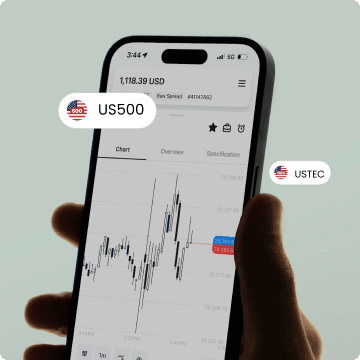
Tap into global market trends
Explore top indices with low and stable spreads.*
Spreads may fluctuate and widen due to factors including market volatility, news releases, economic events, when markets open or close, and the type of instruments being traded.
How the Nasdaq fits my personality as a trader
The Nasdaq's fast-paced environment aligns perfectly with active trading styles that thrive on quick decision-making and technical analysis. Unlike slower-moving indices, the Nasdaq rewards traders who can adapt rapidly to news events, earnings announcements, and sector rotations. The concentration of growth stocks means that momentum strategies and breakout trading techniques are particularly effective.
The index's sensitivity to economic catalysts, including Federal Reserve policy changes and developments in the tech sector, creates predictable patterns that experienced traders can exploit. This predictability, combined with high liquidity and tight spreads, makes the Nasdaq ideal for both scalping and swing trading approaches.
The key benefits I’ve found in trading Nasdaq over other indices
Superior momentum characteristics distinguish the Nasdaq from traditional indices like the S&P 500. Tech stocks tend to exhibit stronger directional moves when breaking out of consolidation patterns, providing better risk-reward ratios for breakout strategies. The sector concentration also means that understanding a smaller universe of companies and their interrelationships can lead to more consistent trading results.
Higher average daily ranges create more profit potential per trade compared to broader market indices. The Nasdaq's volatility clustering, where periods of high volatility follow significant market events, allows traders to position themselves for explosive moves during earnings seasons and major technology announcements.
My daily Nasdaq trading routine
Pre-market analysis and news scans
My trading day begins at 04:00 EST with comprehensive pre-market analysis. The Nasdaq-100 Pre-Market Indicator provides crucial insights into overnight sentiment and potential opening gaps. I focus on identifying stocks with unusual pre-market volume and significant price movements, as these often continue their momentum into regular trading hours.
Key pre-market factors I monitor include:
- Nasdaq futures positioning relative to overnight highs and lows.
- Individual stock reactions to earnings or news announcements.
- Asian and European market performance affecting US tech stocks.
- Cryptocurrency movements, which often correlate with tech stock sentiment.
Key technical levels I mark every morning
Before the market opens, I identify critical support and resistance levels across multiple timeframes. On the Nasdaq 100 ETF (QQQ), I mark:
- Daily pivot points calculated using the previous session's high, low, and close.
- Weekly and monthly support/resistance zones where price has historically reacted.
- Moving average confluence areas, particularly the 21, 50, and 200-period EMAs.
- The previous day's high and low, which often act as psychological levels.
These levels serve as my roadmap for the trading day, helping me identify potential entry and exit points for both long and short positions.
What I look for before entering any trade
My pre-trade checklist ensures consistency and reduces emotional decision-making:
- Trend alignment across multiple timeframes (5-minute, 15-minute, and hourly charts).
- Volume confirmation with above-average participation supporting the move.
- Risk-reward ratio of at least 1:2, with clearly defined stop loss and profit targets.
- Market context consideration, including the overall Nasdaq trend and sector strength.
- Economic calendar review to avoid trading during high-impact news releases.
My core Nasdaq trading setups
Breakout strategy at major levels
Breakout trading remains one of my most reliable Nasdaq strategies, particularly effective during earnings seasons and major technology announcements. I focus on stocks breaking above resistance levels with strong volume confirmation and clear follow-through.
My breakout criteria include:
- Price closing above resistance on increased volume (at least 130% of average).
- No major overhead resistance within the target zone.
- Strong sector or overall market momentum supporting the move.
- Risk management with stops below the breakout level.
This framework builds on how I mastered trading with trendlines to identify cleaner breakout zones.
The key to successful breakout trading is patience,waiting for confirmed breaks rather than anticipating them. False breakouts are common, especially in range-bound markets, so I always wait for end-of-day closes above resistance levels before committing significant capital.

Pullback entries using EMA zones
EMA pullback strategies have become increasingly effective as institutional algorithms respect these dynamic support/resistance levels. I primarily use the 21 EMA for short-term trades and the 78 EMA for longer-term swing positions.
My pullback entry process involves:
- Identifying strong uptrends/downtrends where the price consistently stays above or below the 21 EMA.
- Waiting for healthy retracements/pullback to the EMA zone without breaking below or above.
- Looking for reversal signals like hammer candles or bullish engulfing patterns.
- Entering on the break above the pullback high with stops below the EMA.
This strategy works exceptionally well with Nasdaq stocks because their momentum-driven nature often creates clean pullbacks to moving averages before resuming the primary trend.

Range-trading and failed breakout traps
Range-bound markets present unique opportunities through failed breakout strategies. When the Nasdaq consolidates between defined levels, I trade the reversals at support and resistance boundaries while preparing for eventual breakout confirmation.
My range trading approach:
- Identify clear support and resistance levels with at least three touches.
- Trade reversals at boundaries with tight stops beyond the levels.
- Reduce position size, anticipating lower probability setups.
- Switch to breakout mode when range boundaries are decisively broken.
Failed breakouts often provide the highest probability trades because they trap both momentum and contrarian traders, creating explosive moves in the opposite direction, especially when combined with classic chart patterns for day trading such as double tops, flags, and triangles.

The tools and platforms I use for Nasdaq trading
Indicators I rely on
My essential indicators include:
- Exponential Moving Averages (21, 78, 200) for trend identification.
- Volume Profile to identify high-volume price zones.
- RSI (Relative Strength Index) for momentum confirmation.
- Bollinger Bands for volatility-based entries and exits.
- MACD for trend change confirmation.
My platform's alert system allows me to monitor multiple setups simultaneously without constantly staring at screens.
My order execution setup
These are the key order execution features I utilize:
- Bracket orders for automatic stop loss and profit target management.
- Conditional orders for complex entry strategies.
- Real-time data for understanding market depth and order flow.
How I automate alerts and manage multiple positions
Automation prevents missing opportunities while maintaining discipline. My alert system includes:
- Price alerts at key technical levels.
- Volume spike notifications for unusual activity.
- Moving average cross alerts for trend changes.
- Time-based alerts for pre-market and post-market monitoring.
Position management software helps track risk across multiple trades, ensuring I never exceed predetermined risk limits per trade or overall portfolio exposure.

Risk management rules I never break
My stop loss strategy
Risk management is paramount in Nasdaq trading due to the index's inherent volatility. I never risk more than 2% of my trading capital on any single trade, regardless of conviction level.
My stop loss placement follows specific rules:
- Technical stops below key support levels or moving averages.
- Percentage stops at a maximum of 2-3% for momentum trades.
- Time stops to exit positions that aren't working within expected timeframes.
- Trailing stops to protect profits as trades move favorably.
You can also explore this advanced risk-management in trading guide from Exness Insights for deeper tactics.
Position sizing based on volatility
Position sizing adjusts based on market volatility and individual stock characteristics. During high volatility periods, I reduce position sizes to maintain consistent dollar risk across trades.
My volatility-adjusted sizing formula: Position Size = (Account Risk ÷ Trade Risk) × Volatility Adjustment
When the volatility adjustment decreases by 25–50% during periods when the VIX is above 25, it signifies increased market uncertainty.
Avoiding revenge trading after losses
Emotional control separates successful traders from the majority who lose money. My rules for managing losses include:
- Maximum three losing trades per day before stepping away.
- No position size increases after losing streaks.
- Mandatory cooling-off period after significant losses.
- Trade review process to identify improvement areas without self-blame.
What I’m watching in 2025 for the Nasdaq
Key economic catalysts that could drive movement
Federal Reserve policy and independence remain the primary catalyst for Nasdaq direction in 2025. With officials projecting two potential rate cuts despite elevated inflation concerns, any deviation from expectations could trigger significant volatility.
The effect of tariffs on US inflation and the labor market. Recent weakening in the labor market combined with surging inflation is raising concerns about stagflation in the US economy. The incoming data could cause high volatility for the Nasdaq.
Artificial intelligence developments continue driving individual stock movements and sector rotation. Companies that demonstrate practical AI implementation and revenue generation are likely to outperform, while those falling behind may face significant selling pressure.
Geopolitical tensions and trade policy uncertainty present ongoing risks that could disrupt the technology sector's growth trajectory. Tariff policies and international technology transfer restrictions particularly affect Nasdaq constituents with global operations.
Tech sector themes I think will dominate
AI reasoning and enterprise adoption represent the next phase of artificial intelligence integration. Companies developing practical business applications for AI reasoning capabilities are positioned for exceptional growth, making them prime trading candidates.
Quantum computing advancements could create significant opportunities as the technology moves closer to commercial viability. Early leaders in quantum computing development may experience substantial stock price appreciation as breakthrough announcements emerge.
Cybersecurity and data protection remain critical themes as AI adoption increases cybersecurity risks. Companies providing robust security solutions for AI implementations should benefit from increased demand.
Scenarios I’m preparing for: Bull, bear, and chop
Bull market scenario: Continued AI innovation drives Nasdaq higher, supported by eventual Fed rate cuts and strong earnings growth. In this environment, momentum strategies and breakout trading would be most effective.
Bear market scenario: Stagflation concerns, persistent inflation, or geopolitical crises could trigger significant Nasdaq declines. Defensive positioning and short-selling strategies would become necessary.
Choppy market scenario: Range-bound trading between major levels as conflicting economic signals create uncertainty. This environment favors mean reversion strategies and range trading approaches.
Access top global indices
Trade leading stock indices across the US, UK, China, Germany, and Japan, with ultra-fast execution and low and stable spreads.*
Spreads may fluctuate and widen due to factors including market volatility, news releases, economic events, when markets open or close, and the type of instruments being traded.
Frequently asked questions about Nasdaq trading strategy
What timeframe should I trade the Nasdaq on?
The optimal timeframe depends on your trading style and the amount of time you are willing to commit. Day traders should focus on 5-minute and 15-minute charts for precise entries and exits, while swing traders can use hourly and daily timeframes for longer-term positions. The key is maintaining consistency across your chosen timeframes and ensuring adequate liquidity for your position sizes.
How many trades should I take per day/week?
Quality over quantity remains crucial for Nasdaq trading success. I typically take 2-5 high-probability trades per day, focusing on the best setups rather than forcing trades during poor market conditions. Weekly totals range from 10-25 trades, depending on market volatility and opportunity availability.
Can this strategy be used by beginners?
Beginners should start with trading on an Exness demo account to understand Nasdaq volatility before risking real capital. Remember that the emotional response is totally different when trading with your real money. The strategies outlined here require practice and experience to execute effectively. New traders should begin with smaller position sizes and focus on mastering one setup before adding complexity.
How much capital do I need to start trading the Nasdaq?
Your minimum capital requirements depend on your trading approach. When trading CFDs, you can deploy any amount of capital. However, you must carefully calculate lot size, risk-per-trade, and take profit and stop loss levels to ensure your account's safety before executing trades.
Key takeaways
- Discipline defines every successful Nasdaq trading strategy. Consistently following your trading plan, applying strict risk management, and avoiding emotional decision-making are essential for thriving on the Nasdaq exchange.
- Focus on mastering a few proven trading strategies. Traders who specialize in specific Nasdaq trading strategies, like breakout setups or EMA pullbacks, tend to trade smarter and achieve stronger, more consistent results.
- Technical analysis is the foundation for all trade decisions. Using technical indicators such as moving averages, Relative Strength Index (RSI), and moving average convergence divergence (MACD) helps identify trend direction, key levels, and potential exit points.
- Proper position sizing protects your trading capital. Adapting trade size to market conditions and heightened volatility allows traders to manage risk effectively while pursuing realistic profit targets and avoiding substantial losses.
- Stay vigilant for significant market events and key economic data. Earnings reports, major events, and economic developments can spark rapid price movements in Nasdaq stocks, influencing both short-term and long-term market momentum.
- Market sentiment drives Nasdaq price action. Understanding how market participants and smart money respond to market trends enables traders to anticipate shifts in market price and adapt their trading approach accordingly.
- Day traders and swing traders must adapt to changing conditions. Whether opening or closing positions, day traders and swing traders need to align their trading style with evolving market trends and price movements across the Nasdaq index.
- Risk management strategies determine long-term success. Implementing a systematic approach with clear stop loss levels, defined profit targets, and continuous performance review helps traders sustain growth and protect net asset value.
- Adaptability keeps your strategy profitable in dynamic markets. As financial markets evolve with new technologies and tech giants leading innovation, traders must review their Nasdaq trading strategy regularly to stay aligned with modern market conditions and opportunities.
Final thoughts on my Nasdaq trading strategy
When I reflect on what truly drives success in Nasdaq trading, I’ve learned that discipline matters far more than finding the perfect setup. My trading plan is built on consistent execution—following predefined entry and exit rules, applying strict risk management, and avoiding emotional decision-making even during periods of heightened volatility. Every trader faces temptation when rapid price movements occur, but those who follow a systematic approach tend to protect their trading capital and achieve steady progress. No matter how powerful your technical analysis or how sophisticated your tools are, without discipline and a solid risk management strategy, even a good trading strategy can quickly fail.
For traders aiming to trade Nasdaq successfully, I believe a deep understanding of market trends and market sentiment across the Nasdaq exchange is essential. I focus on the tech giants driving the Nasdaq index, analyzing earnings reports, economic events, and market momentum to guide my trades. My approach centers on mastering a few proven Nasdaq trading strategies—like breakout setups and EMA pullbacks—rather than chasing every opportunity. As day traders or swing traders, we must identify key levels and use reliable technical indicators, such as moving averages and the Relative Strength Index (RSI) to determine trend direction, profit targets, and exit points. The goal isn’t to trade more—it’s to trade smarter, only taking high-probability setups that fit our predefined trading style and position sizing rules.
Looking ahead, I know market conditions will continue to evolve as AI, innovation, and major events reshape the financial markets. My focus remains on staying adaptable while keeping my risk management at the core of everything I do. Whether I’m opening or closing positions, I track market price reactions to significant market events and monitor the average convergence divergence (MACD) for changes in trend direction. By regularly refining my Nasdaq trading strategy, reviewing performance, and adjusting to new market participants and smart money behavior, I can navigate both trending markets and choppy sessions effectively. In the end, success in Nasdaq trading isn’t about predicting every move—it’s about maintaining discipline, managing risk, and executing a proven trading approach that endures across market cycles.
Share:
Related


Exness Trade app
Trade with confidence anytime, anywhere.


Get the app
App title

Trading is risky. T&Cs apply.


